
How should we read robot stories in the wake of A.I.?

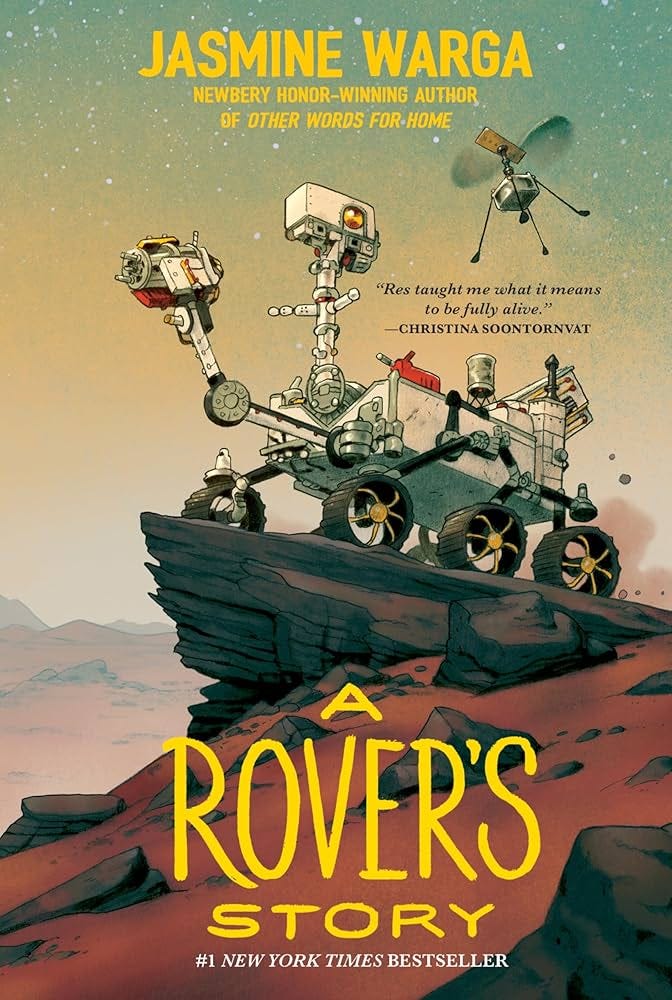
When searching for a new audiobook this past weekend, I felt in my gut that I wanted to read a children’s book. (If I haven’t said it enough, let me say it again…reading children’s lit is like chicken soup for your heart! Try it every once in a while.) I’ve listened to a lot of serious stuff lately, and my reading brain was telling me it wanted a break. After searching through my Libby list, I decided to check out A Rover’s Story by Jasmine Warga.
I’d added this book to my list a few years ago after seeing it on our bestseller shelf at work and being intrigued by the concept. In A Rover’s Story, we bounce between two perspectives—the young daughter (Sophie) of a woman that works at NASA, and the new Mars rover (lovingly named Resilience) that is being worked on there. Resilience is being prepped to visit Mars for the first time and recover past rovers that were lost on their own Mars journeys. The whole world is excited, and is following Resilience as it undergoes tests and prepares to launch. Sophie is excited, too, though less so, because her mom is missing a lot of family time to work on Resilience.
Libby tells me I’m only 25% through, but I’m really enjoying A Rover’s Story so far. Resilience—Res, for short—is really endearing, and reminds me of the endearing nature of robot Roz in The Wild Robot (another book I read and enjoyed within the last couple of years).1 Res is eager to please the humans working on it (who it calls hazmats) and wishes more than anything that it could communicate with them in human language. Res is told over and over by Journey—another robot in the NASA facility—that Res is experiencing things that robots aren’t meant to experience. Feelings are not for robots. Though, Res insists it has them.
After one of these conversations between Res and Journey, I began wondering how a child in 2025 would interpret this book in the age of A.I. Are robot stories making children sympathetic to A.I.? Is it giving A.I. agency, feelings, and opinions, where in reality there are none?
I am not a stranger to the robot story, and the endearing robot story is not new. WALL-E was one of my favorite Disney movies as a kid. Big Hero 6 made me cry the first time I saw it. Back then, robots (in the Hollywood sense) were not part of my daily life. Watching WALL-E felt like watching something foreign, something separate from my life (apart from the commentary on Earth’s decline, which is a whole other essay I could write). I never once thought I would come in contact with a traditional robot as a child, and could therefore very easily categorize the character as fiction.
But now, you can use Chat GPT like a therapist. You can pretend it’s a romantic partner or close friend. It can give the impression that, like Res and Roz, it has feelings. And once you believe something has feelings, it’s much harder to let go of it. Much easier to trust it to do your work for you, to listen to your troubles, to become a part of your routine.
I don’t think A Rover’s Story or The Wild Robot were written with an A.I.-positive agenda in mind—their publication dates alone (2022 and 2016, respectively) indicate that this was really unlikely. And as an adult, I can read A Rover’s Story and The Wild Robot as being distinct from A.I., because I know and can remember life before it. These stories aren’t changing my negative feelings about it. But what will a child five years down the line think when they read these stories that anthropomorphize robots? Will it make them more likely to use Chat GPT for the first time? If A.I. is being thrust into every sphere of existence, how will a young mind be able to differentiate between “good, fictional” and “bad, real” robots?
I’ve been thinking recently about the baby of one of my best friends. She is just over six months old, and will never know a world without A.I. It seems unfathomable to me, though I guess that’s always the feeling when a major technological development occurs. When she is confronted with A.I. for the first time, maybe just trying to google something for a homework assignment, will her immediate reaction be to think of it fondly, remembering the sweet robots she’s read about and watched on tv?
A.I. is quickly becoming unavoidable. It’s on every app I use. It has lessened the quality of search engines that used to be reliable. With no legislation controlling it, the evil robot is reigning supreme with no end in sight. And, unfortunately, a large subset of the population is welcoming it with open arms, without considering the consequences (both near and far).
I will (eventually) continue the Wild Robot series. I will finish A Rover’s Story, and will most likely continue to find the robot narrator charming. But I am scared of what’s to come. I am scared to live in a world with books and music that were never agonized over by a human brain. I am scared for the generation being born right now, who will have no choice in the matter, who will have to deal with devastating environmental consequences and a decreased number of jobs and more we cannot even fathom yet.
I don’t have any answers. Maybe I’m wrong, and maybe kids will be able to recognize what is fiction and what is fact. Maybe I’m worrying for nothing. But, if I’m not, then I think it’s up to us—those that remember what it was like before—to make it clear to them that this doesn’t have to be normal. We can enjoy our stories while also acknowledging that real life is not like The Wild Robot or A Rover’s Story. Real life robots are not the answer to humanity’s woes. They do not, can not, feel like we do.
Last week, I announced that I’ll be offering a very limited quantity of signed books for the holidays. Prices include shipping in the US! Let me know if you have any questions or concerns :-)
You know what else makes a great gift? A monthly postcard in the mail with a poem written specifically for you. Give the gift of poetry to yourself, or to a friend :)
Feeling stuck with your WIP? Need a fresh pair of eyes on your work? Check out my services here.
&, as always, subscribing (paid or free!) to this newsletter is wildly helpful—it’s the easiest way for me to contact y’all!
Thank you for being here.
Until next time,
Caitlin
I think it’s better than the movie, which beats you over the head with themes that were nice and subtle in the book. Plus, you don’t have to listen to that god-awful Maren Morris song when you read the book.
I love this so much! This isn't a book or a movie, but I've been playing Stray on my Switch over the last few days. It's really touching, and touches on robots + humans + AI while acknowledging the harm humans have done. Highly recommend and it has felt like a good middle ground for me.